Most Recent Posts
Summaries of our most recent posts are below. You can also check out our greatest hits or most popular.
AI, The Panda Strike Way (Part 2)

This is the second in a series of posts exploring the strategic approach we take to help our clients navigate the risks and realize the massive quality payoffs of the AI era.
In Part 1, we concluded that, with the emergence of AI tools, we can translate knowledge into value. That sure sounds exciting, but you’ve probably heard it before. In the 1970s and 80s, expert systems, pioneered by researchers like Edward Feigenbaum, aimed to capture the expertise of specialists—such as doctors and chemists—and codify it into rules. This vision hit a wall known as the knowledge acquisition bottleneck: the process…
AI, The Panda Strike Way

This is the first in a series of posts exploring the strategic approach we take to help our clients navigate the risks and realize the massive quality payoffs of the AI era.
At Panda Strike, we’re not AI skeptics, but we may come across that way. The reality is that we’re AI optimists, but that’s overshadowed by the fact that we’re all drowning in a tsunami of hype. Indeed, LLMs are a remarkable leap forward in natural language processing. As such, they’re useful tools for a variety of…
From Around The Web

From Around The Web is based on an internal thing we’ve been doing that I figured might be useful to share and a good way to revive our blog, which has gone through a few false reboots over the years. Basically, it’s mostly just curated things…well, from around the Web, with occasional commentary.
EU DMA Is For Real

When the EU’s DMA and its cousin, the DSA, passed in 2022, I was surprised. First, it had gone from a proposal to law in less than two years. Second, and more to the point, from what I could tell (not being a lawyer), it looked like a serious attempt to regulate Big Tech. I had always believed it…
CISA Open Source Safety Analysis

The US cybersecurity agency analyzed popular open-source projects and found that many widely used projects still contain a lot of unsafe code.
Projects still relying on unsafe code include: Linux, Chrome (Chromium), Firefox (Gecko), Node, PHP, Python, Redis, Postgres, MySQL, OpenSSH, and OpenSSL.
RIAA Sues AI Music Companies

The RIAA joins the New York Times in claiming that training LLMs does not constitute “fair use.”
I’m not a fan of either organization, but these lawsuits seem to have merit and, in any event, raise legitimate questions about the relationship between AI and fair use. Cory Doctorow seems concerned that limiting fair use is at odds with stronger regulation and organizing, but that doesn’t follow…
InterOp 2024

InterOp has led to a tremendous improvement in browser interoperability, particularly with newer features. So it’s great that they’ve set new goals for 2024. Of particular interest, they’re beginning to turn their attention toward WASM:
As well as focus areas, Interop 2024 will also feature a new investigation into improving the integration of WebAssembly testing into web-platform-tests. This will open…
New Cloud Graph Database

I am very excited to announce Graphite, our serverless graph database technology, which we developed with one of our clients and can now share with you. In fact, we’re so excited about this technology, we’re shifting our focus to helping clients leverage it.
Self-Assembling Clients For HTTP APIs

Today I’m excited to introduce the Sky client, making it easy to integrate with any Sky API you build. I’m also announcing Panda Sky v2.6, featuring a couple new command line features to help with testing.
Panda Sky and its accompanying ecosystem are designed to make writing serverless apps painless. The Sky client makes it easy to use a…
Log Tailing for API Deployments

Sky 2.5 introduces a new, handy feature: log tailing. You can now look at your entire deployment’s log trace from the comfort of your own terminal.
Panda Sky adds value by stitching together existing Cloud technologies from AWS and guiding you toward an effective way to use them. But serverless architectures require a to developer to update their…
Sky Mixins And A Sundog Preview

Happy New Year! I’m proud to announce Sky v2.4. This version includes support for mixins - entities that extend Sky’s deployment and command line features. This post will show you what kind of features are now available, as well as a preview of Sundog, a new project aiming to be a functional version of the AWS SDK.
Functional Mixins In JavaScript

Mixins add behavior to a type (or class) without relying on inheritance. JavaScript has nice prototype-based types and recently added classes, but lacks first-class mixins. Fortunately, it provides everything we need to implement them. Since we use mixins for Play, our library for creating native Web Components, I thought I’d share our approach here.
Introducing Panda Sky, Severless APIs Made Easy

We are really excited by the potential of serverless architectures to provide a simpler and more reliable way to deploy modern Web and mobile apps. However, serverless is still relatively new, and, like any new technology, it can be difficult to workt with. We wanted to make it easier, so we built Panda Sky.
Introducing Play, A React-Like Web Components Library

We’ve been fans of Web Components since they were first announced. We had the opportunity to experiment with them, and with Polymer, in particular. But we were frankly disappointed in the results. Our team, like many developers, found React, and React-inspired frameworks easier to use. What was missing was the simplicity of React, but for Web Components. So I built it.
Padding Blocks with PyCrypto in Google App Engine

Assume (for the sake of argument; no need to tell us why) that one day you find yourself working with Python in Google App Engine, using PyCrypto to encrypt secrets. Unless your plaintexts are always a multiple of 16 bytes in length, you are likely to run into this error…
Your Password Policy Is Wrong

Earlier this year, I received a marketing email from LifeLock, which linked to a post warning of the ills of weak passwords, and inferring if ‘Zuck isn’t too cool to have his accounts compromised, neither are we.
Unfortunately, the folks at LifeLock don’t appear to be experts in effective password strength policies. I want to address the following statement specifically…
Google Fiber Is A Death Star

Google Fiber’s big announcement last week, that they’re going to “pause” the rollout of Google Fiber in new cities, in combination with the resignation of CEO Craig Barratt, led to a lot of speculation that this particular letter in the Alphabet is in trouble. Everyone from Ars Technica to The Washington Post had some fun with this story. So why not us?
Do IoT Botnet DDoS Attacks Threaten The Internet?

The following is an edited transcript of an internal Panda Strike Slack discussion, in which we assess implications of the recent IoT-based DDoS attack and conclude that we need to drink delicious beer.
Dan So the Internets are freaking out today about how people’s toasters have become an attack vector. Take this Tweet as a fairly representative example…
Soft Deletes In HTTP APIs

A fun question came up the other day on our internal Slack channel:
For soft-deletes (where we keep a record in the database, but set a flag that it’s been deleted), we’re trying to decide between doing that with
DELETE <resource>orPUT <resource>with a body{status: 'deleted'}. That way, we can reserveDELETEfor hard deletes. Any recommendations?Visualizing Distributed Load Tests and Kibana
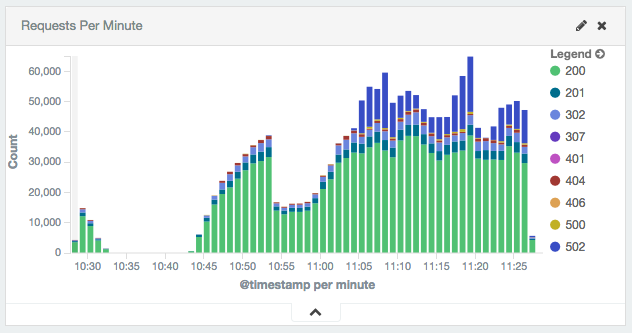
Apache JMeter is a flexible tool for producing load against an application and measuring the results. We used it on a recent project to measure performance of a large and complex web site. The results of the performance tests required aggregation and visualization. The performance tests required a scale-out approach since the desired request rate exceeded the capabilities of a…
Version Media Types, Not URLs

Roy Fielding’s advice on versioning APIs is, well, succinct:
In a subsequent interview, he thankfully clarifies:
Websites don’t come with version numbers attached because they never need to.
Neither should a RESTful API.
In one of our own posts on HTTP, we hinted that HTTP does, in fact, support versioning. After all, as Fielding says in that same interview…
Microservices And Serverless Architecture

One of our favorite patterns at Panda Strike is to have an HTTP API that dispatches jobs to workers. We called this the dispatcher-worker pattern, but its names are exceeded only by its variations. In particular, it’s a variation of the microservices pattern.
Design Patterns In HTTP

We’ve made the case on this blog that REST is the wrong way to try and understand HTTP. We’ve also said that it’s worthy of study if only because the Web runs over HTTP. We’ve even contributed a few introductory blog posts to the subject.
SpaceX Wallpaper From Unsplash.com

I am a fan of SpaceX and the work that they are doing to get the human race to Mars and beyond. I am also a fan of having new desktop wallpapers.
Browsing the web I saw a link to SpaceX’s unsplash.com profile, and instantly wanted their incredible photos as my desktop wallpaper. My goal was to always…
You Can't Turn The Network Invisible

Last year, Jafar Husain gave a presentation about Falcor and how Falcor has changed how Netflix handles it APIs. Falcor, like Relay, is a clever bit of programming with an alluring promise to simplify network programming via a powerful abstraction. But we’ve already followed this seductive sirens’ song, many times before, and it usually doesn’t end well.
Creating SSL Certs With Let's Encrypt

Let’s Encrypt is a free Certificate Authority for TLS, which we believe is a crucial advance for the Open Web. ZeroSSL takes the great work Let’s Encrypt is doing one step farther, by making it easier to create LE certs. So there’s more reason than ever to protect your Web sites or apps with TLS. In this post, we’re going to walk you through using ZeroSSL to generate a cert…
Anywhere Is Everywhere

The following is an excerpt from our upcoming book about remote work, The Global Office.
Success stories for remote work are common in the software business. The Linux operating system was developed via remote collaboration, along with all its various distributions, and thousands of other open source software libraries. There’s GitHub and Basecamp (formerly 37Signals) and dozens of lesser known but successful software companies, all of whom work remotely.
HTTP Is The New Lisp

This is Greenspun’s Tenth Rule:
Any sufficiently complicated C or Fortran program contains an ad hoc, informally-specified, bug-ridden, slow implementation of half of Common Lisp.
You can tell how old it is by the fact that C and Fortran are given as examples of popular languages. We don’t personally know this Greenspun person, but let’s just assume he hung out with Ada and Alan back in the day.
Machine Learning And Big Data Is All Just Fun And Games

Analytics and machine learning are increasingly relevant tools in the software professional’s toolbox. Statistics and probability now play a greater role than ever in our work.
Games can be a fun “gateway drug” for learning these techniques. In particular, the sports industry has recently turned to mathematics in the quest to gain a competitive advantage. Organizations like FiveThirtyEight, originally…
Facebook React And A Party Gone Wrong: A Socractic Dialog

Recent buzz about Facebook React—I guess there was a conference or an announcement or something?—inspired an internal discussion here at Panda Strike. We’re on the record as not being big fans of the framework, but, as a group of smart, spirited software professionals, we sometimes disagree. Our respective opinions on Facebook React, and possibly many other things, may differ from those…
More Agile Than Agile Itself

One of the big ironies of the discussion around remote work is that some Agile gurus have said that remote work is incompatible with Agile development. This couldn’t be more false.
The truth is precisely the opposite: remote work is inherently more Agile than any Agile development methodology.
Examples of using Blocks in Ansible 2

We use Ansible a lot for infrastructure automation.
One of the exciting new features in Ansible 2 is blocks.
Ansible blocks allow you to group tasks and apply things to those groupings.
For using Ansible blocks we recommend using at least Ansible 2.0.1 which was released on January 24th and includes some important improvements to blocks.
Docker Swarm With AWS VPC

Docker offers a feature rich platform for Linux containers. Amazon Web Services offers a feature rich platform for cloud computing. Naturally, we want to use them together. In particular, we want to use Docker Swarm running within an AWS VPC. Unfortunately, this isn’t quite as easy as you might think. Here’s our solution.
A YAML Command Line Processor

YAML is our favorite data format. Popularized by Ruby and Rails, YAML is powerful and expressive. Consequently, it’s seeing increasing adoption, everywhere from dev ops tools, such as Docker or Ansible, to static site generators.
So it was surprising to discover the relative paucity of tools for processing YAML from the command-line. The few that do exist didn’t meet our needs, so…
HTTP And The Zombie Apocalypse

HTTP is the world’s most successful application protocol. Yet it is widely maligned and misunderstood. Part of the problem is a poor developer experience. Part of the problem is that a Ph.D. dissertation is usually not the best introduction to a subject. And part of the problem is that building network applications is hard and we blame HTTP for that when we shouldn’t.
REST Won't Help You Understand HTTP

The HTTP protocol gets a bad rap. HTTP is simply an application protocol that provides a well-considered set of features for distributed applications. Naming, caching, compression, and so forth, are not superfluous complications introduced by HTTP. They’re just things distributed applications need to do. HTTP is annoying because distributed computing is annoying.
The Four Keys When Hiring Remote

Hiring is hard. Hiring technical people well is harder. Hiring technical people that work remotely is even harder. To be good at it, you need to already be good at hiring. You can build on that to become good at hiring remote workers.
Remote Work's Greatest Challenge

We’re working on a book about remote work. One of our goals is to honestly discuss the challenges in working remotely. We’ve already written about some of them. You may have to change the way you think about managing. You may need to get better at assessing your team’s productivity. You probably will need to adapt your development process. Our upcoming book will dive into these in more detail. But there’s one challenge that I believe is the biggest of them all. And it’s one we haven’t written about, until now.
Brave Is Interesting But Ad-Blockers Are Better For The Web

Brendan Eich’s latest venture is Brave, a browser platform that blocks ads and trackers while encouraging people to pay for content. Brendan has done a lot for the Open Web, founding Mozilla at a time when Microsoft was threatening to turn the Web into a proprietary technology, and working all the while to improve JavaScript. And I don’t doubt that his latest…
We're Writing The Book On Remote Work

As you may know, Panda Strike is a 100% remote work company. We’ve been so since we started back in 2012. During the past couple of years, we noticed that interest in remote work appears to be increasing. So we thought we’d share what we’ve learned in an ebook on the subject, which we plan on making available in February. Join our mailing list and…